Does your dog struggle to stay home alone?
Causes and training strategies for separation anxiety in dogs.
Structured 1:1 online coaching for dogs with separation anxiet, individualized, professional and pressure-free.
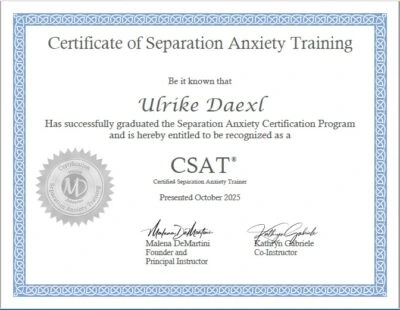
- CSAT certified under Malena DeMartini
- Specialized in separation anxiety
- Structured, gradual step-by-step training approach
- Individual 1:1 online guidance
You are not alone with this problem.
Many dog owners experience something similar.
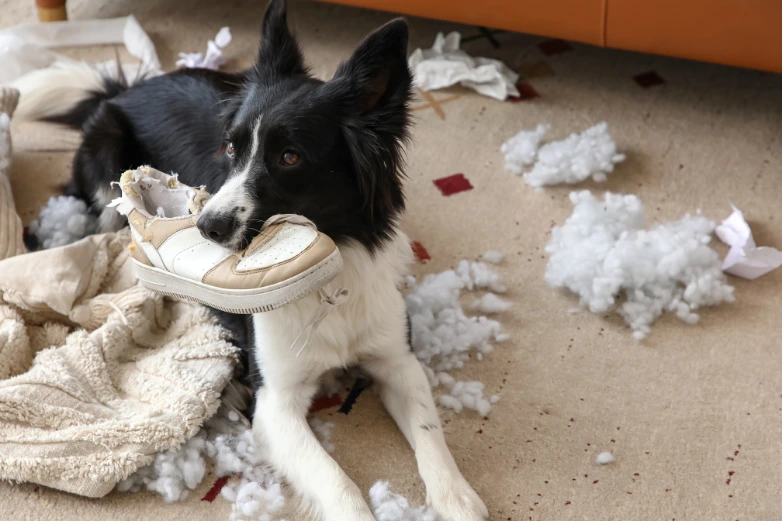
Their dog barks, whines or becomes distressed as soon as they leave. Neighbors complain, plans are cancelled and daily life revolves around this issue.
Often, many approaches have already been tried – with little success.
This leads to frustration, uncertainty and sometimes even feelings of guilt.
It is important to understand: separation anxiety is not a training issue.
It requires a different, specialized approach.
What I mean by “separation anxiety”
On this page, separation anxiety is used as an umbrella term for all separation-related issues that occur when a dog is left alone—regardless of whether it is clinically referred to as separation anxiety, isolation distress, or hyperattachment.
As a Certified Separation Anxiety Trainer (CSAT), I follow Malena DeMartini’s approach:
What matters is how much stress your dog experiences when left alone—not the exact label we use for it.

Your dog panics as soon as you close the door behind you.

Neighbors complain about barking or whining.

You find destroyed objects when you come home.

Your quality of life is significantly restricted due to constant worry.

You feel helpless because common advice has not helped so far.
Separation anxiety is not a training problem.
Many well-intended tips do not help with separation anxiety. This is not about disobedience, but about stress that your dog cannot simply switch off. That is why separation anxiety requires a clear, structured and specialized approach.
Separation anxiety is stress, not defiance
Separation anxiety manifests itself in stress reactions. What your dog needs now is safety and a structured training program in small steps. Your dog cannot behave differently at this moment.
Standard training often falls short
Exercise and mental stimulation are important, but they do not solve separation anxiety. What really helps is structured alone time training, tailored specifically to your dog.
Structure instead of trial and error
Many owners try out different approaches over a period of months. An individual training approach with regular reassessments and feedback leads to significantly more stability and ultimately to safety for the dog.
Guided support makes the difference
Separation anxiety is individual. That is why I work in 1:1 sessions, with personal analysis and training that is consistently adapted to your dog and her needs.
If you like, we can clarify in a consultation call whether your dog shows signs of genuine separation anxiety and which course of action makes sense.
Want to dive deeper?
In my article, I explain in detail how separation anxiety manifests itself and why conventional methods often fail. –> Understanding Separation Anxiety in Dogs
How the 4-week intensive
program works
You receive clear, structured training plans, individualized guidance and continuous feedback, tailored to your dog and your daily life.
1
Detailed initial assessment
First, we conduct a thorough assessment and evaluate Live-video-recordings. This allows us to determine whether separation anxiety is present and how pronounced it is.
2
Individual training plans
You receive up to four personalized training plans per week. The steps are carefully structured and adapted to your dog’s current stress level.
3
Daily feedback
On four training days per week, you receive feedback on your observations (shared via Google Drive). This allows us to adjust early and guide your dog safely and steadily through the training process.
4
Weekly live reassessment
Once per week, we meet for a personal online session. We evaluate progress and adjust the training plan if necessary.
5
Clear perspective
After four weeks, you will have a realistic assessment of your dog’s progress. If needed, the program can be extended.
Expert Articles by Ulrike Däxl
These articles are designed for dog owners dealing with separation-related problems.
They help you understand what your dog is actually experiencing when left alone and how to identify true separation anxiety.
Rather than offering generic advice, the focus is on clear analysis, common pitfalls and a structured, evidence-based approach to your dog’s behavior.


What dog owners say about my work.
Structure, expertise and individual guidance are the foundation of my work. Here are some responses from dog owners.
Investment in professional support
Separation anxiety affects everyday life. Structured, individualized guidance brings clarity and sustainable training progress. Below you will find a transparent overview of the program.
Four-Week Intensive Separation Anxiety Program (Online, CSAT)
Individual 1:1 guidance including assessment, personalized training plans and continuous feedback.
890,-- €
- Detailed initial assessment
- Up to four personalized training plans per week
- Daily feedback on four training days
- Weekly live reassessment
- Individual adjustment of training
Extension month
750,-- €
If your dog needs additional stabilization, the program can be extended for another four weeks. The scope remains the same, including personalized training plans and continuous adjustments.
Check-in session (60 minutes)
130,-- €
After completing the program, individual online sessions can be booked. These sessions are suitable for follow-up questions or reviewing progress.
Why does the program cost €890 (or €750 for a renewal)?
This includes daily one-on-one support 5 out of 7 days a week: For each training day, I create a new plan tailored to your dog, evaluate your feedback, and observe your dog’s progress on its own once a week via live video. The remaining two days are intentionally left free—a break for you, your dog, and me. That’s the effort that makes all the difference.
All prices are final prices. No VAT is charged or shown under § 19 UStG.
Your contact person for separation anxiety in dogs
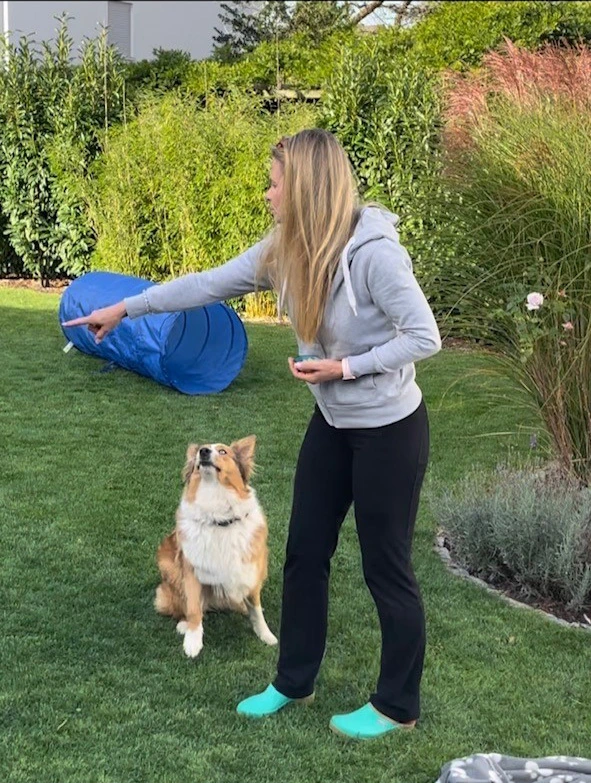
Separation anxiety is a highly specialized topic that requires experience, precise observation and a structured approach. I have deliberately focused on this field because generic training methods are often not sufficient when a dog experiences stress during separation.
As a Certified Separation Anxiety Trainer (CSAT), trained under Malena DeMartini, I work with a science-based, stress-oriented training approach. The focus is not on obedience, but on helping your dog gradually learn to cope with being alone in a calm and sustainable way.
Separation anxiety can significantly affect everyday life. Appointments are cancelled, neighbors complain, and even short absences become emotionally challenging. It is important to understand that this behavior is not defiance. It is a stress reaction.
In my work, I combine structured assessment, individualized training plans and continuous evaluation of progress. Each step is adapted to your dog’s current stress level and development. There are no standardized programs, but clear, measurable steps.
My goal is to guide you professionally and transparently through the entire training process so that both you and your dog regain stability and confidence in everyday life.
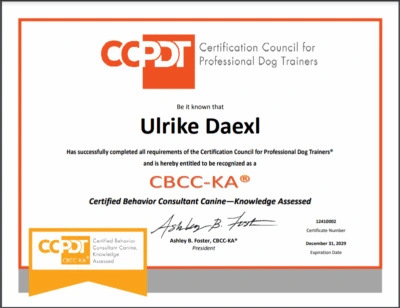
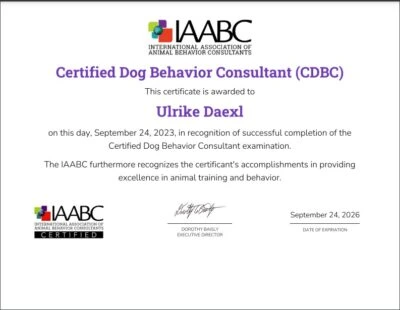
- CSAT certified under Malena DeMartini
- Specialized in separation anxiety
- Structured, gradual step-by-step training approach
- Individual 1:1 online guidance
Frequently Asked Questions about Separation Anxiety in Dogs
Why does my dog bark when he is left alone?
If a dog barks as soon as he is left alone, this can be a sign of stress or separation anxiety. In many cases, it is not about defiance or a lack of training, but an emotional reaction to being alone. A proper assessment is usually based on video analysis and a structured evaluation of the situation.
Why does my dog howl or whine he is left alone?
Howling when a dog is left alone can also indicate emotional stress. Some dogs vocalize because they feel insecure or anxious without their attachment person. Similar to barking, howling is often a signal that the dog is struggling to cope with the situation of being alone.
Is separation anxiety a result of poor training?
No. Separation anxiety is not the same as missing training or poor obedience. It is an emotional stress response. While training can help build confidence and gradually improve the dog’s ability to stay alone, the underlying issue is anxiety rather than disobedience.
What kind of help is available for dogs with separation anxiety?
Support usually involves a structured and gradual training process that helps the dog slowly build confidence when being alone. In many cases this includes video analysis, individualized training steps, and ongoing guidance so the dog can learn to remain calm without experiencing panic.
Does the training also work online?
Did you know that this is actually the best approach? Thanks to modern technology, this gives us the perfect opportunity to keep an eye on the dog and observe him when he’s home alone. Video analysis allows us to provide structured guidance throughout the training process.
Is this training suitable for every dog?
Most dogs with separation-related stress can benefit from structured training. However, every dog and every situation is different. That is why the first step is always a careful assessment to determine whether this approach is appropriate.
How long does it take to see the first progress?
This depends on the individual dog and the severity of the anxiety. Some dogs show small improvements relatively quickly, while others require more time and patience. The key factor is a gradual and structured training approach.
What happens if my dog still cannot stay alone after four weeks?
Progress in separation anxiety training is highly individual. If a dog still struggles after four weeks, the training plan is adjusted and continued step by step. The goal is not speed, but sustainable progress and long-term emotional stability.
Do I have to train every day?
Consistency is important. In most cases, short and structured training sessions areintegrated into everyday life four times a week, and on one day we conduct a livereassessment together.
Can puppies also suffer from separation anxiety?
Yes, puppies can also suffer from separation anxiety or develop it. In this case, the training protocol focuses primarily on establishing “successful alone time.”
Let Us Clarify Your Situation Together
If you are unsure whether your dog is experiencing separation anxiety, we can take a closer look at your individual situation in a personal consultation.
In this call, we will discuss your dog’s behavior, clarify whether separation anxiety may be present, and determine which structured steps would make sense for you and your dog.
You will receive an honest and professional assessment of your current situation and clear guidance on possible next steps.
Places in the 1:1 program are intentionally limited to guarantee focused and personalized support.
Contact Me
Please briefly describe how your dog’s situation currently presents itself. I will review your request carefully and provide you with an honest assessment of how we can proceed in a meaningful way.
- +49 178 8936900
- info@hund-trennungsangst.de